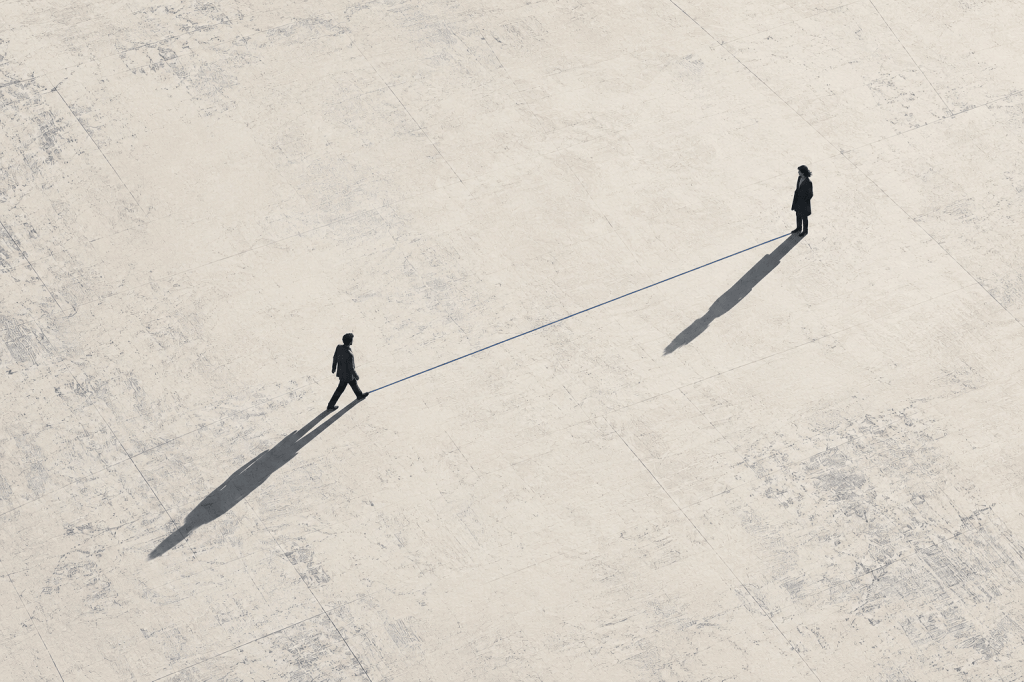
A Notarist is a witness.
A Notarist is a human being who intentionally witnesses the action of another human being. The person being witnessed is the notaree.
Notarists are artists. They serve no official capacity whatsoever. There is no central authority, no certification, and no governing body. As such, anyone can be a Notarist.
Practically speaking, a Notarist witnesses an action in real life, while physically present. The witnessing must happen in real time, in person, with the Notarist paying close attention to what is unfolding.
Notarism’s medium is spacetime. Its goal is acknowledgement.
Acknowledgement
What the notaree receives is not a verdict. It is acknowledgement. To witness someone is to say, without needing the words, “I am aware of you, of your presence before me.”
The focus is the notaree, not the Notarist.
The Witnessing Is the Work
A Notarist’s artwork is the act of witnessing itself. Like music and dance, it can be considered a performance. Uniquely, Notarist’s can also leave a record.
A record can take any form: a short written attestation, a sketch, a photograph, a recording, a score, or a three-movement symphony. Each is an attestation that a human action was witnessed by another human being. A record carries the moment with it. A record is not required. Without one, the work is still complete.
Witnessing is not a function of the senses. It is awareness: one human being aware of another, present before them. A Notarist who can neither see nor hear can still witness fully.
There are no rules governing how a Notarist witnesses. It may happen through conversation, movement, touch, or silence. What matters is not completeness, but presence.
Notarism in Practice
Over two weeks in April 2026, on a Wednesday and then a Saturday, I set up a small table near the Hermosa Beach Pier. Fifteen people stopped each time. Each received a white 5×7 postcard printed with “Hermosa Beach” and the coordinates of my table, 33.8617, -118.4016. With colored pens, they wrote their name, or anything at all. I signed with the date and time, stamped “Witnessed” in red, and wrote the date in the stamp’s oval. They chose how many star-shaped holes to punch in the card; the record was 14. Finally I folded the upper left corner down, a Notarist’s bookmark. My sign read “Get written proof that you were actually here.”
A Notarist may sit with a student through an examination and produce a simple written statement noting the time, place, and conditions under which the work was done.
A Notarist may witness a painter creating a portrait and respond by composing a piece of music that reflects the pace, tension, and atmosphere of that moment.
A Notarist may witness a couple exchanging vows in a living room and later produce a single photograph and a handwritten paragraph describing the light, the scent of the flowers, and the silence before the first word was spoken.
In each case, the Notarist was there. That is the point.
Presence
Notarism begins with presence.
The root of every Notarist act is the shared physical presence of two human beings in the same moment. The witnessing cannot be reconstructed later or inferred from data alone. Presence is not data. It is the foundation.
This presence is mutual. A Notarist does not witness in secret. The notaree must know they are being witnessed. They may have invited it. They may have simply agreed to it. But both parties are aware, and both parties are present.
Notarism is not surveillance. Surveillance captures. Notarism attends.
The Point
Every human being, at every moment, occupies a point on the earth that no one else can hold. A latitude, a longitude, an instant in time. That spacetime point is theirs alone, and it will never be held again.
This is the anchor. A Notarist’s work is grounded there, to the one place in spacetime where the notaree was, and where another human being was aware of them.
Symbolic Truth
Notarism does not attempt to prove objective truth. It does not replace technical verification, legal certification, or machine-based systems of record.
A Notarist does not certify facts. A Notarist bears witness.
The result is symbolic truth rather than bureaucratic truth.
Two Notarists may witness the same action and produce entirely different works. Both are valid. Witnessing is not passive capture. It is an act of attention, interpretation, and care.
In the hands of a Notarist, witnessing becomes an aesthetic act.
Fidelity
Not all witnessing is equal, but the difference is not in what it proves.
Fidelity is the depth of a Notarist’s awareness and presence. A Notarist who stays a little longer, who gives the moment more of themselves, witnesses with greater fidelity. Fidelity is not a matter of how many senses are engaged. It deepens with time, and with care.
Fidelity is not measured by how much is captured, but by how fully the Notarist was there.
Several Notarists witnessing the same action do not, by definition, add up to a stronger proof. The notaree receives several acknowledgements, each its own work.
Lineage
In Rome, the notarius had no authority of his own; what made the act count was that he was there. Notarism borrows that aesthetic, not its officialdom, and keeps company with artists who put spacetime and humanity ahead of the object: Tino Sehgal, On Kawara, and Felix Gonzalez-Torres.
Why Notarism
Notarism exists to honor human action in a world increasingly mediated, automated, and inferred.
It is not anti-technology. It is technology-ambivalent.
A machine can record. A machine cannot witness.
Notarim begins with the decision to notice and record a human action.
Anyone can be a Notarist.
This is a re-blog of a Medium post from last March.


Leave a Reply