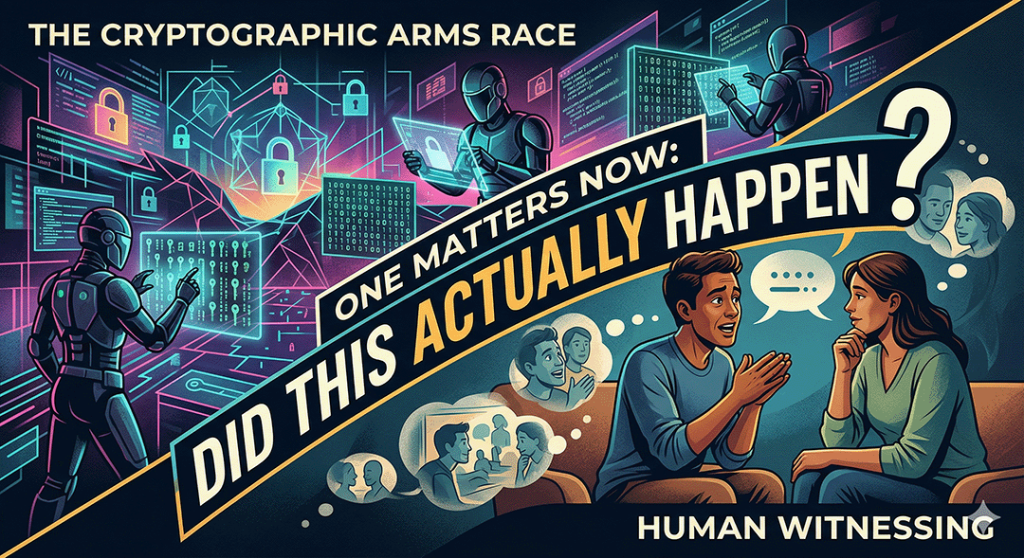
The cryptographic arms race and human witnessing answer different questions. One matters now: did this actually happen?
We are living through a subtle but consequential rupture in how human beings establish truth together.
One system is highly visible and increasingly strained. It is built from cryptographic signatures, certificate authorities, blockchain timestamps, and biometric verification. It secures the flow of digital information and allows strangers to coordinate across distance. The other system is older and less visible. It is based on human witnessing. People who were present. People who observed. People who are willing to stand behind what they saw.
Notarism is a simple idea that emerges from that older system. Some claims about reality cannot be established by examining a record, no matter how well secured it is. A photo, video, or document can be proven intact and tied to a source. That tells you the record has not been altered and where it came from. It does not tell you whether what it shows actually happened. For that, you need a person who was there, someone willing to stand behind what they observed.
The difficulty in distinguishing these two systems, and in understanding the limits of each, is becoming a critical cultural test.
The Question Digital Systems Answer
There is a diagram that appears early in most cryptography textbooks. Two parties, Alice and Bob, exchange a message across an untrusted channel. An adversary sits between them. The central problem is how to guarantee that what Alice sends is what Bob receives, unaltered and authentically hers.
The mathematics built around this problem includes public key infrastructure, elliptic curve cryptography, zero knowledge proofs, and hash functions. These ideas support digital commerce, private communication, and the infrastructure of modern networks.
The diagram is precise about what it covers. It secures the message in transit. It establishes origin and integrity. It does not address whether the message corresponds to reality. It does not ask whether the event described actually occurred, or whether anyone is willing to stand behind it.
That boundary has always existed. It is becoming more visible now.
The Arms Race Has a History
Digital trust has long depended on the assumption that certain computations are infeasible within practical limits.
Over time, those limits shift. Systems once considered secure have failed as computation improved. The Data Encryption Standard, approved in 1977, was broken by a specialized machine within a day by the end of the century. SHA 1, once widely trusted for verifying data integrity, was retired after collision attacks became feasible at a cost within reach of determined actors.
Each transition follows a familiar pattern. A scheme is trusted. Computational capability grows. The assumptions weaken. A new scheme replaces the old one.
Quantum computing extends this trajectory. Shor’s algorithm shows that certain widely used cryptographic systems can be broken once sufficient capability exists. New approaches are being developed, and the cycle will continue.
Security based on computational hardness evolves continuously. Its durability depends on staying ahead of available compute.
The Rupture That Precedes the Breach
Before those limits are reached, a different pressure has already emerged.
Generative AI makes it possible to produce convincing images, videos, and documents of events that never occurred. These can be created at scale, at low cost, and without specialized expertise.
This does not depend on breaking encryption. It operates before authentication is even relevant. A convincing record can be produced without intercepting or altering any existing communication.
The consequence is a shift in how evidence is perceived. The issue is not only the existence of fabricated material, but the fact that any record is now plausibly fabricated. This has been described as the liar’s dividend, where the presence of synthetic content makes genuine material easier to dismiss.
A signed record can establish that it has not been altered. A timestamp can establish when it existed. These remain valuable capabilities. They do not establish whether the underlying event took place.
Two Worlds, Permanently Parallel
A clearer distinction is emerging between two forms of trust.
Cryptographic systems cannot establish whether an event occurred. They confirm that a record has not been altered and that it originated from a particular source. They do not determine whether the content reflects reality.
Witnessing systems cannot ensure the integrity of information as it moves through networks. They do not scale to large volumes of transactions. They do not eliminate the possibility of error or deception.
These systems coexist because the questions they answer are not interchangeable. Each operates within its own limits. The evidentiary structure of witnessing does not depend on computational difficulty and does not change as computing power increases. Its reliability is shaped by human factors rather than technical ones.
A familiar example helps clarify the boundary. A notary public does not verify that the contents of a document are true. A notary does not investigate whether the events described actually occurred. The notary verifies something narrower. A specific person appeared, proved their identity, and signed the document in the notary’s presence. The system records a moment of human presence tied to an act. The truth of what is written remains outside its scope.
Why Notarism
For much of the digital era, the distinction between these systems had limited practical impact. Most records reflected real events. Treating technical verification as a proxy for truth produced acceptable outcomes in many cases.
That condition is changing. Synthetic content is increasing dramatically in volume and quality. Records that appear reliable can no longer be assumed to correspond to real events.
Systems such as World ID establish that a human being exists behind an account and that the credential is unique. Notarism addresses a different dimension. It establishes that a human being was present at a particular moment and is willing to stand behind what they observed.
The practice of Notarism makes the witnessing system explicit. It records not only the content of a moment but the human connection to it. Who was present, what they observed, when and where it occurred, and whether they are willing to stand behind the account.
Living in Both Worlds
Individuals and institutions already operate within both systems. Businesses secure communications while requiring witnessed agreements. Hospitals protect records while requiring observed consent. Courts accept digital evidence and rely on testimony.
The coexistence is longstanding. The consequences of confusion are increasing.
Clarity about which questions belong to which system supports more reliable decisions. Some questions concern the integrity of information. Others concern whether an event occurred and who can attest to it.
Alice and Bob remain in the diagram, exchanging messages across an untrusted channel. Mathematical methods will continue to evolve. Protocols will continue to adapt.
A more basic question sits outside that frame. Did this event occur, and is there a person who is willing to stand behind that account?
That question has always belonged to a different system. Recognizing the distinction between the two is becoming essential to how we establish truth together.
Notarist — notarist.org · Essay Series — On Witnessing
 psemme
Leave a comment