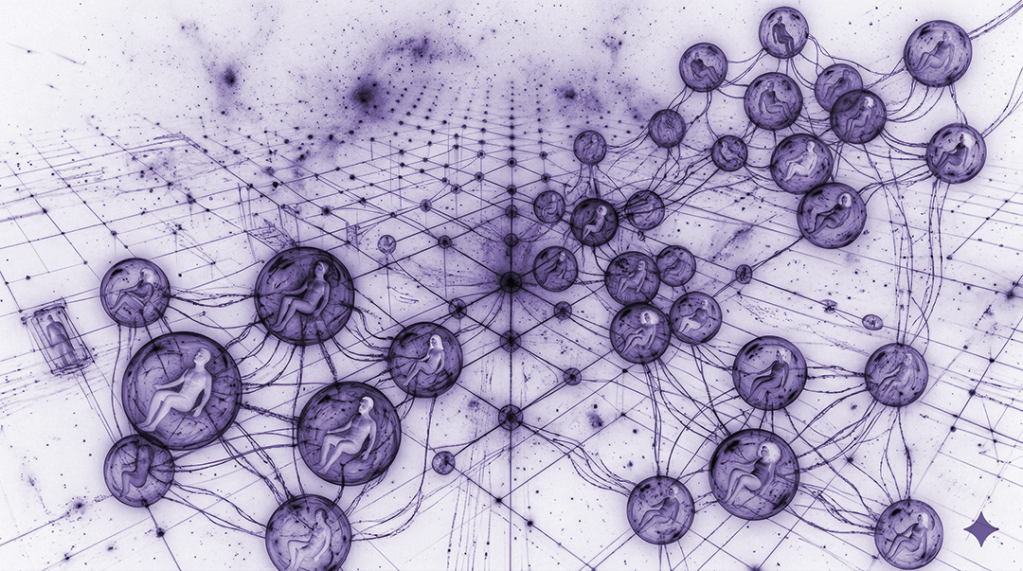
A speculative design for a social network where every account is verifiably human
Imagine a social network built on a single refusal.
No bots. No synthetic identities. No invisible swarm of ghost accounts simulating a public. Every account belongs to a human being who has been vouched for by another human being who was actually there when they signed up.
Not authenticated by a credit card, nor phone number, nor government ID uploaded into a database. Not even by the biometric certainty of a machine (hello world.org). Instead, verified by presence: one person witnessing another person, and accepting the social burden of saying, I saw this human being with my own eyes.
It sounds almost archaic, and that is part of why it feels radical.
We have spent years building platforms that treat identity as a technical problem. But identity was never only technical. It was always social. Long before passwords, surveillance systems, and the industrialization of trust, people knew each other by encounter, by repetition, by the accumulation of memory. A name mattered because someone could stand behind it.
That older logic is not obsolete. It has simply been buried under scale.
Presence as proof
The central insight here is not just “verified humans.” It is that verification becomes meaningful when it is costly enough to matter.
In a system built on real attestations (“this person is a real human”), the act of vouching is not a disposable click. It is a claim about a person, made by someone who risks their own standing if the claim is false. Trust is no longer outsourced to a distant platform or collapsed into a checkbox. It is carried through relationships, the way trust has always moved in small groups.
But it is important to be precise about what this proves.
Presence can establish that a person exists. It cannot, on its own, establish that they are honest, reliable, or acting in good faith. Humans lie to each other in person all the time. Friends vouch for friends too easily. Social pressure can distort judgment. A witnessed identity is not a guarantee of integrity. It is a floor, not a ceiling.
That distinction matters because the modern internet has made identity cheap to fake and expensive to believe. Research on reputation systems has long shown that any system built on trust has to confront collusion, strategic behavior, and laundering through social ties. In other words: the problem is not whether people can be verified. The problem is whether verification can survive incentives to cheat.
And yet the premise still holds. Humans are not only isolated agents; they are networked beings. Generalized trust, social ties, and access to resources are deeply linked, and social networks remain one of the main ways trust becomes usable in real life. A social platform that acknowledges is solving the trust issue by relocating it.
What it feels like to enter
The first thing you would notice is gravity.
Every post would carry a little more weight because the person behind it is not an abstraction. They are not a disposable handle, not a burner account, not a temporary performance. They exist in a chain of witnesses. Their presence has been socially situated.
That changes how language behaves.
We are so used to reading online speech as if it were detached from consequence that we forget how much of our online life is built on asymmetry: one person can wound, provoke, or manipulate, and then vanish behind anonymity or scale. Remove that asymmetry and the tone of conversation changes. It slows. It becomes more deliberate. Less theatrical. Less optimized for punishment or applause.
This is not because people become saints. They do not. But when anonymity is no longer the default and identity carries relational weight, self-presentation tends to become less cartoonish. Research on social media suggests that authentic self-expression is associated with better well-being, while self-idealizing behavior can be psychologically costly. Another study found that perceived authenticity on social media predicted fewer mental health symptoms later, especially among people who felt more socially connected. In plain English: being more genuinely oneself online is not just morally appealing; it may also be psychologically healthier.[5][8]
That matters here because this network is not merely filtering identity. It is trying to create conditions under which people can appear as themselves without having to become brand-shaped versions of themselves.
The shape of the feed
The feed would feel unlike any feed we know. No follower-count theater. No public like tallies. No performance of scale as a proxy for worth. Those numbers would not disappear entirely, but they would be pushed into the background, where they belong. The visible surface of the network would be people, not metrics.
But removing metrics does not remove status. It changes how status is expressed.
Instead of numbers, reputation would flow through relationships: who vouched for whom, who is connected to whom, who shows up repeatedly in meaningful exchanges. Hierarchies would still emerge, but they would be social rather than purely numerical. Harder to scale, harder to game in the same way, but not impossible to distort.
And the order of things would change too. The feed would not be dominated by whatever can provoke the fastest response. It would be roughly chronological, or at least lightly weighted toward people with whom you have actual relational history, i.e. people you have replied to, met, witnessed, or been witnessed by.
That kind of structure matters because trust and network position are not just decorative features of social life; they shape access to resources and legitimacy. Studies of generalized trust and interpersonal networks suggest that weak ties and network structure matter greatly for how social resources are distributed. A network designed to prioritize real connections rather than indiscriminate reach is structurally different.
This is also where the Dunbar constraint returns as a truth. Human beings do not maintain meaningful relations at infinite scale. The number may vary, but the principle does not: there is a cognitive limit to how many people we can truly know and track. Popular discussions of Dunbar’s number often place meaningful social circles around 150, and even if the exact number is debated, the underlying insight remains widely useful: trust is local, and intimacy has a ceiling.
So the network should not pretend to be a planet-sized village. It should behave like a federation of villages.
And that comes with a trade: it will be harder to enter, slower to grow, and more unevenly distributed across geographies and communities. What it gains in coherence, it risks in accessibility.
Why this changes conversation
If the internet taught us anything, it is that speech becomes stranger when accountability disappears.
People become more cruel when they do not have to live among the consequences of what they say. They become more extreme when applause is cheap. They become more performative when the audience is abstract. A network of witnessed humans would not eliminate conflict — nor should it — but it would restore friction. And friction is often what makes conversation real.
There is a reason so many communities in the offline world are governed by repetition, proximity, and memory. If you know you will see someone again, you tend to speak differently. Not always better. But differently. The speech becomes thicker with context.
That is the promise here: not politeness, but continuity.
And continuity is rare online. Most platforms are built to erase it. They reward novelty, recency, and velocity. They flatten history into feed time. But a witness-based network would remember. Not in the surveillance sense, not as a giant machine quietly harvesting behavior, but in the human sense, where memory is relational and reputational rather than extractive.
The deeper promise
What such a network makes possible is what I would call credible coordination.
If identity is grounded in real relationships, then coordination becomes easier. People can hire, refer, invite, collaborate, and debate without first having to solve for basic legitimacy. This is the part that goes beyond social media and starts to look like infrastructure. In a high-trust network, a person’s reputation can travel through actual relationships rather than synthetic signals.
But it is worth saying simply: this approach does not democratize identity. It re-localizes it.
Access to opportunity would flow through networks of trust, which can be uneven, exclusionary, and shaped by existing social structures. The system would be more human, but not necessarily more fair.
That tension is the cost of grounding identity in relationships rather than abstractions. It’s a feature not a flaw.
Still, the possibility is real. Communities, marketplaces, working groups, and mutual aid systems could be built on something sturdier than engagement metrics or verification badges.
This is why the idea feels bigger than a platform. It is closer to a protocol for social reality.
The strongest systems are often the ones that do less, but do it more honestly. They do not try to optimize human beings into content factories. They do not mistake visibility for value. They do not confuse scale with meaning. They assume that the thing worth preserving is not attention, but trust.
Why it is hard
Of course, the problem is that humans are excellent at gaming human systems.
A witness-based network would not be immune to collusion. People would form attestation rings. Friends would vouch for friends too easily. Social capital would become a resource that could be hoarded, traded, or abused. Reputation systems have always had to confront this problem; collusion is not a bug on the margins, it is one of the central design problems.[12][13][11]
The witnessing mechanism would have to be scarce, expensive, and accountable. It would need limits on how often someone can vouch, decay over time, and mechanisms that reward careful judgment rather than indiscriminate generosity.
But even then, the system cannot guarantee truth. It can only make falsehood more socially expensive.
There is also the question of scale. The more ambitious the network becomes, the more it risks losing the very intimacy it was designed to protect. A trust graph can become a maze. Subcultures can harden into islands. Local trust can turn into social closedness.
And there is a more immediate challenge: how it begins.
A network like this cannot grow frictionlessly. It depends on existing relationships. It expands unevenly. It may cluster in certain cities, professions, or communities before others. The cold start problem is both technical and social.
So the design problem is larger than just verification. It is how to grow without dissolving the very constraints that give the system meaning.
The unresolved beauty of it
What makes the idea compelling is that it refuses one of the internet’s oldest lies: that scale is always better.
Maybe it isn’t.
Maybe what humans actually need is not another infinite stream of strangers, but a digital environment where presence has consequences, where speech accrues history, where identity is earned through being encountered, and where trust is not a product to be extracted but a condition to be maintained.
A witness-based network would not be faster than the platforms we have now. It would not be easier to grow. It would not be as profitable in the usual sense. It would not be as open.
But it might be more legible as a human system. And perhaps that is the point. Not to build a bigger internet. To build one where identity is not infinitely portable, frictionless, and cheap, but situated, relational, and costly enough to matter.
 psemme
Leave a comment