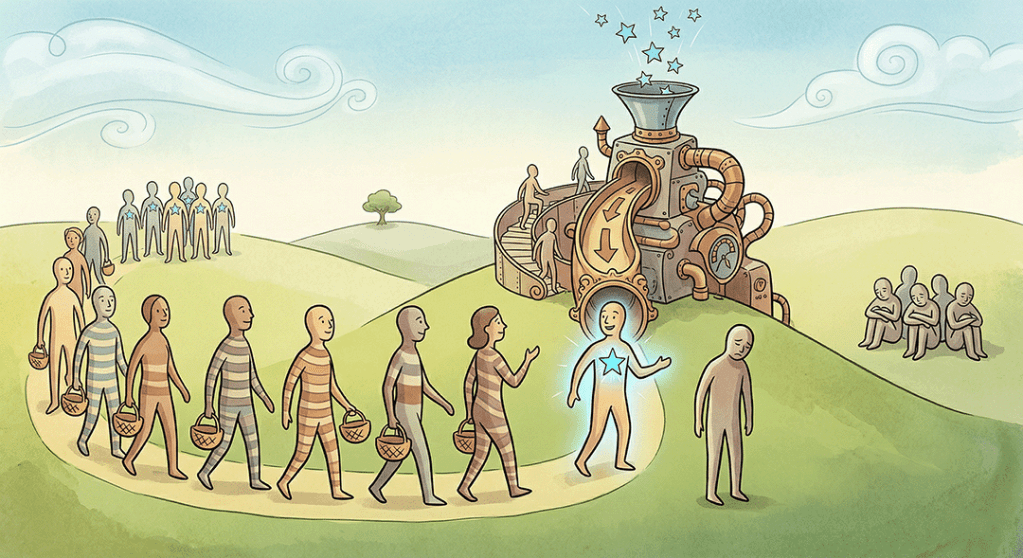
Long before social media, Dr. Seuss wrote a near-perfect parable about status.
You know the Sneetches. Star-bellies lorded their status over plain-bellies, until Sylvester McBean arrived with his machine. It put stars on, took stars off, for $3 a pop, and it pushed the whole island into confusion. By the end, nobody could remember who was original. The marker had detached entirely from any underlying reality. McBean drove off rich. The Sneetches were broke and exhausted.
The story is usually read as a lesson about vanity. But that misses the deeper problem. The Sneetches were always going to care about social status, it’s an inescapable Sneetch (aka human) constant. What McBean actually destroyed was their ability to know anything real about each other. Once the signal became detached from any verifiable reality, the community itself fell apart.
We’ve been living in an extended Sneetch cycle for decades, and it’s accelerating.
The Blue Checkmark
On Twitter, the blue checkmark once functioned as a scarce signal of authenticity. For journalists, athletes, officials, the check meant this person is who they claim to be. It was coveted and meaningful. A form of social verification that, at its peak, applied to more than 420,000 accounts [Variety] carefully vetted by the platform.
Then the platform ran the symbol through its own version of McBean’s machine. For a monthly fee, anyone could acquire the same mark. The results were immediate and revealing. A wave of celebrities, including LeBron James, Stephen King, and Chrissy Teigen, took pains to emphasize that while they still had a blue checkmark, they had not paid for it. [Section]
Teigen, discovering the badge had been automatically restored to her account, called it punishment [ABC News] and worked out how to remove it. King tweeted that the platform was falsely showing he had subscribed. LeBron had previously announced he wouldn’t pay. The company’s response to the chaos was to have its owner personally cover the subscription fees for a handful of holdouts, which, if anything, deepened the absurdity.
Think about what that shift represents: the Twitter blue checkmark, months earlier a coveted status symbol, was now something celebrities were publicly disavowing. A marker of authenticity had become a signal of performative authenticity, something to disclaim rather than display. [CNN]
Scarcity had produced signal. Access produced noise.
Degrees
The same mechanism has played out more slowly in higher education. A bachelor’s degree was once rare enough to communicate real differentiation. As degrees became more common, employers began using them less as proof of specific knowledge and more as filtering tools, demanding credentials for roles that hadn’t previously required them. By one measure, 65 percent of job postings for executive secretaries and assistants now require a bachelor’s degree, while only 19 percent of people currently working in those roles actually have one. [Wikipedia]
The machine kept running. Bachelor’s was no longer enough; master’s became the new baseline. In 2000, 19 percent of workers earning between $80,000 and $100,000 held a graduate degree. By 2021, that proportion had risen to 26 percent, and appears to be accelerating. [FREOPP]
Meanwhile, the credentials multiplied faster than the roles that justified them. More than half of college graduates now begin their careers in jobs that don’t require their degree, and 44 percent are still in that position ten years later. [Marketplace]
The star no longer signals what it cost.
Followers
The most visible version of symbolic inflation is social media follower-ship, where artificial amplification through bots and click farms has long made it difficult to distinguish genuine, from manufactured, attention. But the more consequential development is what’s come next. The problem is no longer just that follower counts can be purchased. It’s that entire credible public identities can now be assembled from nothing.
Terms like “best-selling,” “award-winning,” and “expert” already circulate so widely that they communicate less about achievement than about willingness to play the signaling game. Generative AI extends that dynamic from marketing language to identity itself, complete with publishing records, speaking bios, professional histories, and comment trails that look indistinguishable from a life actually lived.
The Pattern
In his 1991 book Inflation of Symbols, sociologist Orrin Klapp described this dynamic: the oversupply of status tokens degrades their social purchasing power. Standing ovations become automatic. Medals become ubiquitous. Greeting cards become formulaic. The pattern is consistent across contexts.
Scarcity generates signal. Replication generates noise.
What is different today is not the mechanism but the speed, and the scope of what can be replicated. For the first time, the machine can manufacture not only status markers but the people wielding them. AI systems can produce synthetic conference speakers, fabricated professional histories, and fully artificial online personas sustained indefinitely at the cost of a subscription.
This is where the Sneetch problem gets serious. Humans have always competed for status, and always will, there is no version of society in which that changes. But status competition only functions when participants can make reasonable assumptions about who they’re actually dealing with. When anyone can be anyone, and any credential can be generated, the epistemic foundation of community life starts to give way. It’s not that people care too much about status. It’s that the signals they’re using to navigate it have become unreliable to the point of uselessness.
The Infrastructure Problem
This is where Notarism enters, not as a philosophical remedy for status anxiety, but as an infrastructure response to epistemic collapse.
The original meaning of “social” was grounded in something physical: real people, in real places, known to each other through repeated presence and mutual witness. The reputations that mattered were built in communities where participants could be held accountable because they were identifiable. Status, influence, trust, all of it ran on a foundation of verifiable human identity.
Digital life has successfully stripped out the infrastructure that had always quietly supplied it.
A Notarist record doesn’t tell you whether someone is powerful, credentialed, or worth admiring. It tells you something more foundational: that this person is real, was present, and was witnessed by another human being who can be held accountable for that attestation. It cannot be purchased remotely or generated at scale. It requires someone to show up, pay attention, and attest: I was here. This happened. I saw it.
That’s not a cure for the Sneetch problem. The Sneetches will always want stars. But if you’re going to have a community with real stakes, real trust, real reputation, real social consequences, the participants need to be verifiably real first.
McBean’s machine works because nobody can check. Notarism is a check.
The Sneetches’ real problem was never vanity. It was that they lost the ability to know who anyone actually was.
 psemme
Leave a comment