Why humans create new art forms — and why credibility may now require one of its own
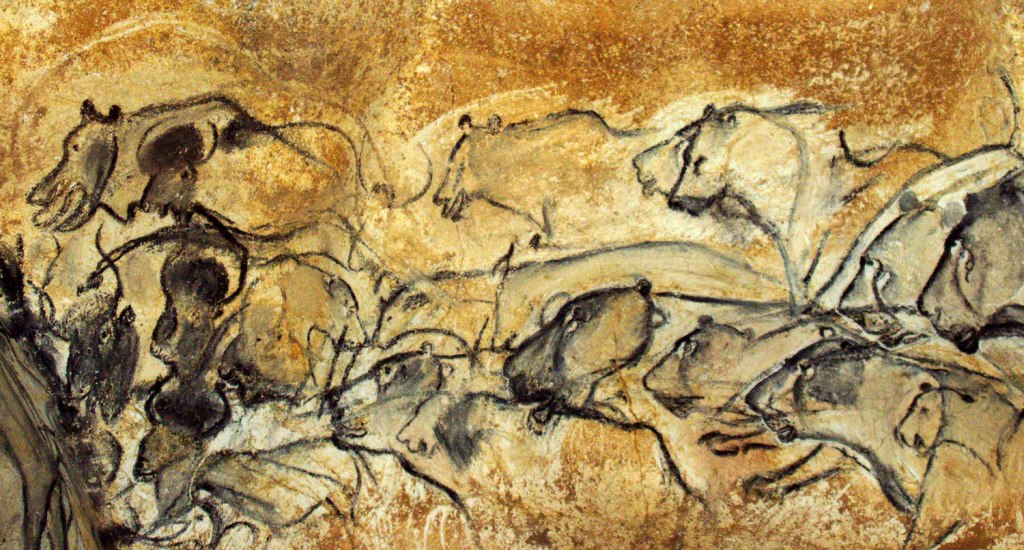
Around 36,000 years ago, deep inside what we now call Chauvet Cave in southern France, someone pressed charcoal to limestone and drew a lion.
Not a crude mark. Not an accident. A lion with shading, motion, and perspective, rendered with a sophistication that stunned archaeologists when the cave was discovered in 1994.
Radiocarbon dating later confirmed that the images belonged to the Aurignacian period. What surprised researchers most was not simply the age of the drawings, but the implication: the people who made them arrived in Europe with a fully formed artistic tradition.
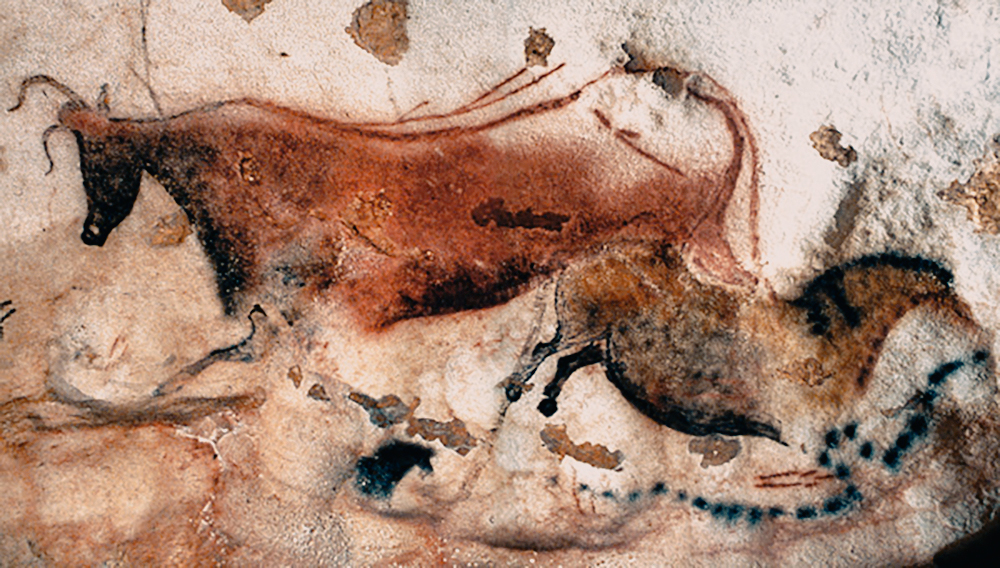
Fifteen thousand years later, at Lascaux, painters covered cave walls with hundreds of animals — horses, bulls, stags, bison — using mineral pigments blown through hollow bones. At both sites, newer images were layered over older ones, suggesting that the act of making the image may have mattered more than preserving the finished composition.
This detail is important. It suggests that early art was not decorative. It was existential.
Something in the human mind required that what had been seen — a hunt, an animal, an event — be made durable. Experience was fleeting. The wall could hold what memory could not.
The earliest art we know appears to be motivated by a fundamental need:
to stabilize reality by giving it form.
But recording was not the only human need reaching expression at that time.
In the Swabian Jura of southern Germany, archaeologists have uncovered bone flutes dating to roughly 40,000–43,000 years ago. Carefully carved from griffon vulture wing bones and mammoth ivory, these instruments were capable of producing melodies.
Researchers at institutions including the University of Tübingen and Oxford have suggested that music may have helped early human groups coordinate socially, strengthen bonds, and maintain cohesion across larger populations.
If cave painting externalized memory, music externalized feeling.
One recorded the world. The other transmitted interior states that language could not fully carry. Two art forms, emerging within a similar timeframe, responding to different human pressures.
This pattern — art forms arising when a psychological or social need becomes urgent enough to demand its own medium — repeats throughout history.
Theater in ancient Greece provided a space to rehearse moral conflict and consequence. Aristotle’s description of catharsis framed drama as a way to process emotions too dangerous or complex for everyday life. Dance gave form to embodied knowledge. Architecture transformed shelter into meaning through proportion, light, and orientation.
Art forms do not appear randomly. They emerge when existing forms can no longer contain what humans need to do.
Photography is perhaps the clearest modern example.
When publicly announced in 1839, photography was immediately understood not just as a new artistic technique, but as a new trust technology. Unlike painting, which required interpretation, the photograph appeared to deliver reality directly. Light itself — not the artist’s hand — was assumed to inscribe the image.
Within decades, photographs were used in journalism, warfare documentation, scientific study, and legal evidence. Portrait studios flourished because people sought what they called “true likenesses.” Courts began accepting photographic evidence. The cultural phrase “seeing is believing” took hold.
Photography did not merely expand artistic possibility. It mechanized witnessing.
For roughly a century and a half, despite known manipulation techniques, the default cultural assumption remained: a photograph implied that someone — or something — had been there.
That assumption is now under strain.
Synthetic media systems can generate convincing images, video, and speech without any underlying event having occurred. Voice models can reproduce vocal identity from brief samples. Visual deepfakes can maintain continuity of lighting, expression, and motion across sequences. Studies have shown that human observers often struggle to reliably distinguish high-quality synthetic media from authentic recordings.
The institutional response has been logical: cryptographic provenance standards, watermarking initiatives, detection models, and verification frameworks such as those being developed by the Coalition for Content Provenance and Authenticity (C2PA). These efforts aim to restore trust by making machine-generated content traceable.
But they address a technological problem with technological solutions.
They do not fully address the cultural rupture beneath it:
For the first time in human history, the ability to produce a convincing record of an event is no longer dependent on anyone having witnessed that event.
Photography once attempted to mechanize witnessing. Synthetic media now mechanizes fabrication.
The link between record and presence — which underpinned modern trust in documentation — is weakening.
To understand why this matters, it helps to step further back.
For most of human history, trust did not require formal systems because witnessing was ambient. In small, face-to-face communities, actions were visible. Reputation formed through repeated co-presence. Memory was distributed socially. People did not need symbolic practices dedicated to verification because daily life itself functioned as verification.
Urbanization, mass media, and digital networks gradually separated action from audience. Documentation technologies partially compensated by preserving traces that implied presence.
When those technologies lose credibility, the underlying human need does not disappear. It intensifies.
Anthropologists and evolutionary biologists have long noted the importance of costly signaling in human cooperation. Behaviors that require effort, time, or risk — from ritual participation to gift exchange — can function as credible indicators of sincerity. Trust is often established not through efficiency, but through visible investment.
Attention itself can be costly.
Being physically present at a specific time and place, choosing to observe rather than simulate observation, creates a form of signal that cannot easily be replicated by automated systems.
This is the context in which Notarism begins to make sense.
Notarism proposes that intentional human witnessing can be treated as an artistic medium. A Notarist is physically present while a human action takes place. Both parties are aware — the actor and the witness. Afterward, the Notarist produces a record: a written statement, a sketch, a photograph, a symbolic mark.
A Notarist might witness a painter creating a portrait and respond not with a photograph of the canvas but with a short composition — a piece of music reflecting the pace, tension, and atmosphere of the room while the work was made. The resulting record would say nothing forensic about the painting. It would say something true about the experience of watching it come into being.
This record is the artwork.
It is not legal evidence.
It does not claim objectivity.
It does not attempt technological verification.
Its credibility derives from something simpler and older:
a human being chose to be there and to pay attention.
Where photography sought to eliminate subjectivity, notarist practice embraces it. Imperfection becomes part of the signal. The value lies not in forensic accuracy but in the existence of a witnessed moment.
In this sense, Notarism is not an evolution of documentary media. It is a re-humanization of witnessing.
Is such a practice reasonable in an age of synthetic records?
Consider the trajectory of trust mechanisms over the past two centuries.
- Mechanical recording expanded belief in documentation.
- Digital manipulation introduced skepticism.
- Generative systems now challenge the assumption that records correspond to events at all.
Technological responses will continue — and should. But they operate within the same domain as the systems they seek to regulate.
Human witnessing operates in a different domain: that of embodied presence, mutual awareness, and interpersonal accountability.
A machine can generate a representation. A machine cannot experience being there.
As digital artifacts become infinitely reproducible, lived moments may acquire new cultural value. Presence itself may become a scarce resource.
Historically, when human needs shift, symbolic practices shift with them. New rituals, new media, and new art forms emerge to stabilize experience.
If early art stabilized memory, and photography stabilized representation, emerging practices like Notarism may succeed at stabilizing belief.
Notarism
Notarism began as a concept in 2022 and has developed gradually as an open practice. It has no governing body and no certification process. Anyone can act as a witness. The medium is attention.
This weekend, I will be standing at Hermosa Beach Pier with a small stack of cards, a pen, and a stamp. If someone chooses to stop, I will witness their presence at that location and moment, then hand them a signed record. I keep nothing. They leave with the only copy.
It is a modest gesture. But I intend to repeat it, in different places, with different passers-by, because I believe people will recognize the value of being witnessed, even before they have language for why.
Today, as synthetic systems make it possible to fabricate any record, the simple act of one human being deliberately paying attention to another may become meaningful again.
Trust has always had an aesthetic — from clay seals to wax impressions to photographic likenesses. In our time, that aesthetic may shift once more. Not toward more perfect representations, but toward more credible experiences.
And that shift, if it continues, may itself become art.
Peter Semmelhack is the founder of notarist.org. The foundational text on Notarism, “The Art of Witnessing,” is available at medium.com/@notarist
 psemme
Leave a comment