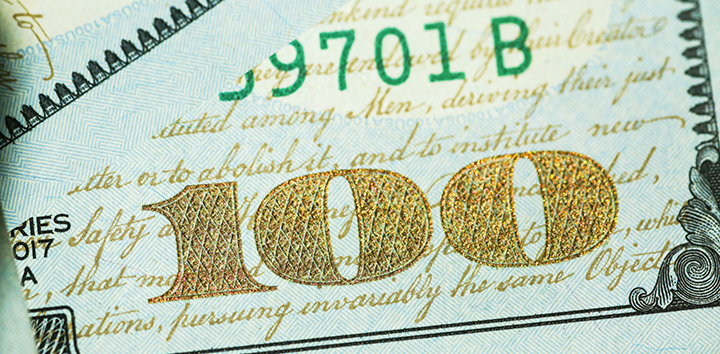
Walking home you discover, to your delight, a $100 bill resting on the sidewalk. You smile, bend down, pick it up, and continue on your way.
You’re excited because this $100 note has given you new power: the permission to spend. You are now permitted to trade its unique combination of paper + ink for all kinds of goods and services within the dollar trading system.
It was an impersonal acquisition. The same power would have been conferred equally to any other lucky finder. With paper currency, whomever is in possession of – owns – the note, is granted the power/permission.
And, like all types of power, there is an attendant, tacit responsibility. How will you expend this new resource? To do good? To be frivolous? To do evil?
10eo, is an art form with a similar framework. Instead of a currency, there are algorithms. Possessing a 10eo algorithm (algo) confers both permission and responsibility to the owner – permission to execute (perform) the algo’s instructions and the responsibility to do it accurately.
A 10eo performance’s value relies on the algo’s precise execution, much like a pianist playing a Mozart sonata. In addition, the performer has wide interpretive latitude whose value is entirely subjective.
Most importantly, a 10eo performance is a form of existential proof – a declaration to the universe that “I existed at this place and time”.
10eo is similar to music and theater in that it comprises two elements – an instruction set and a performance. And like those art forms, 10eo can have separate parties involved in each element. Algo authors can be physically/temporally separate from their algo’s performer(s). Each party has certain roles and responsibilities.
Algos
An algo is a series of instructions created by an “author”. Each instruction is called a “transient”. Performers execute each transient as precisely as possible. At the end of each transient’s execution the performer is required to provide some form of proof-of-effort (PoE), or evidence that they did, in fact, perform the transient as instructed . The more irrefutable the PoE, the better (see Notarists section below). Including PoE in a 10eo piece increases its value.
There are no rules for how to create an algo, though there are certain styles that authors can adopt. For example, adsum, which is a style that requires specific time and location parameters for each transient – e.g. “go here, at this date and time, and do this“.
If an adsum algo’s performer does not abide by the date/time requirements, the piece will complete with no value. The date/time element also limits the algo to only one performance.
Algos can be written instructions on a page, a diagram chiseled in marble or a song sung to an audience. Authors can make algos available in any way they choose – again, no rules.
Once an algo is made available, it can be performed. A 10eo performance starts the moment an individual takes possession of it, like picking up a $100 bill off the street.
An author could pin a paper-based algo to a telephone pole. The moment it is plucked from the pole, the performance begins – the new owner is both permitted, and responsible for, following, performing, its transients.
The author could make the algo available as a mint-able NFT. In this case, the date/time of the mint becomes the date/time of possession, which starts that 10eo piece’s performance. With this approach, NFT collectors become performers – an active participant in the accrued value of the asset they just acquired – a unique form of collaboration. An algo may require that the performer store/log the piece’s outcome + PoE (see below) on a blockchain where it is made available to the next performer, ad infinitum.
Performances
The performer is responsible for the accurate execution of an algo. The performer’s precision is the basis for the piece’s overall value.
PoE is a performance’s second most valuable aspect as it serves to prove that the performer is human, not a robot or AI. PoE, when done properly, is an existential proof, or proof of humanity (see Notarist section below).
Therefore, the output of a 10eo performance has two components – any artifacts created from the algo’s transient execution (e.g. a drawing) and the PoE, in whatever form it is supplied, for each transient.
There are no “official” PoE guidelines. A performer uses PoE to increase the value of their piece. The more irrefutable the evidence of accurate transient performance, the higher the value. PoE could include:
- Notarist witness to transient execution.
- Live (non-notarist) witness(es) to a transient execution- willing to sign a document stating they witnessed the performance.
- For adsum algos, a securely recorded video of a performance in front of a public date/time display in a specific, known location is also a good example.
Notarists
A notarist is an existential notary – a specialist who provides proof of humanity (PoH) documentation to individuals. Since 10eo is based on the human performance of algos, notarists can serve as both transient execution witness and implicit PoH provider.
10eo performances with notarist-provided PoE are considered the most valuable.
All notarist interactions happen IRL with no digital interfaces.
Photo by Giorgio Trovato on Unsplash
 psemme
Leave a comment