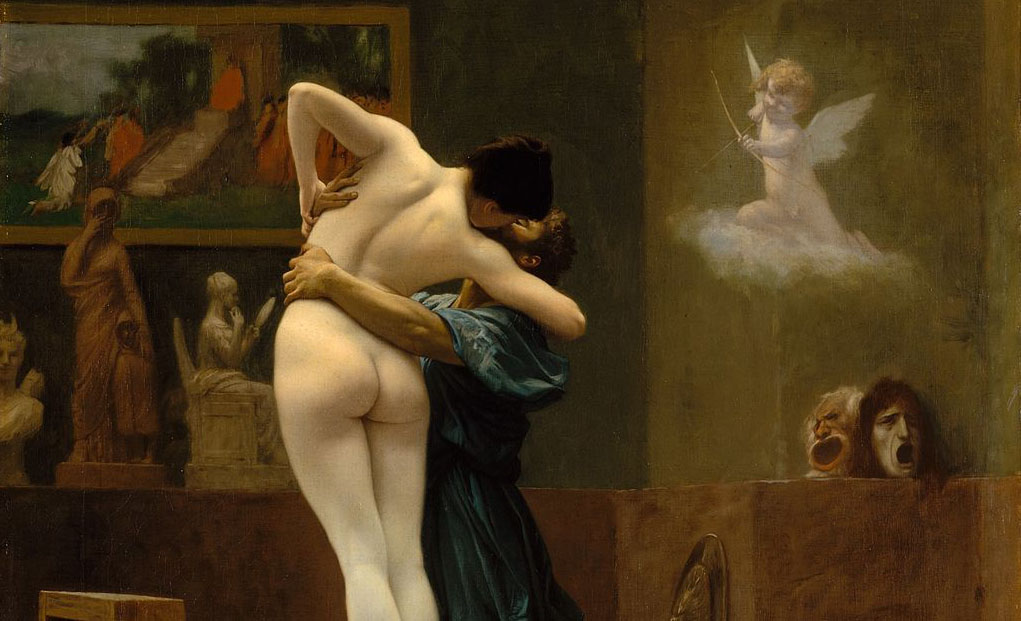
We’ve been here before.
It’s been hard to fully digest all that’s happened in AI over the past couple of months. So many apt analogies apply but for me it feels like we are all about to go over Niagara Falls in a barrel. It could be fine, fun even. But on the other hand, are we insane? I am both frightened and comforted by the fact this moment feels deeply human – that humanity has wrestled with these situations for as long as we’ve existed. Like Pygmalion, we are struggling to come to terms with our creations.
I feel what I’ve been trying to articulate is suddenly more relevant. What started as a purely artistic pursuit now feels like it has more utilitarian (urgent?) implications – namely, the need for a root source of truth. In an emerging digital world where literally anything can be faked, what and/or who can you trust? What is “real” suddenly seems precious. Sources of truth/trust are ancient needs. But digital tools add a scale dimension that drastically changes the acceleration, velocity and impact of the fake, unauthentic, deceptive and, dare I say evil, actors, human or otherwise.
Here, dear reader, you will not be surprised when I say “awareness” is the root. Awareness is truth. This is why I love the phrase “I am”. What could be more true? I don’t believe an AI will ever “be” in the same way. Certainly we share the same space-time continuum, but an AI will never experience it like we do, as a function of awareness. Some philosophers would argue that without awareness, the universe would cease to exist. I tend to agree. Awareness is the observer, without which there is nothing.
“I am” is timeless. Its essence is objective truth. As such it’s a good starting point. It’s when you add objects that it becomes more complicated.
“I am human.”
“I am here.”
“I am who I say I am.”
These subjective qualifiers become candidates for verification. Absent any type of artificial intermediary, these statements can be verified by one, or more, human observers in close physical proximity. The observer then projects their awareness – “I am” becomes “you are” and the verification is complete. This interaction process has formed the basis for authenticated communications since the time of the Pharaohs and is still used today.
Recently, and astonishingly, digital technologies are appearing that aim to prove your humanity. Called “Proof of Personhood” (PoP) systems, they aim to create platforms with blockchain-based, digital IDs that can be used, when needed, to prove you are not an AI. Here’s an example. Their appearance presages a new zero-trust digital world, and adds another layer of noise to the already cacophonous ecosystem. I have little faith these will work being made of (and by?) the same systems they purportedly protect against. Every system can be hacked. Simplicity should be the goal.
I will misquote Maslow – “To an AI with a hammer, everything looks like a nail”. I worry that he have built this proclivity into our systems. In some cases it will be brilliant, but in others potentially catastrophic. Are we sculpting a beautiful, new Galatea? My intuition tells me we are and all the lessons passed down over the millennia still apply. If our creations have advanced to the point where they have ceased to behave in ways we can control, it’s time to take a step back – meaning, can we trust an uncontrollable system to be our arbiter of truth? The answer is obvious.
I am guilty of being a “hammer” as well. I believe in humanity. We need to trust each other, authentically – which may mean eliminating artificial interfaces. Maybe digital systems will become untrustworthy, at scale. Maybe the AI revolution will have the opposite effect on us. It will teach us to rely LESS on technical systems because they become global amplifiers of our worst human impulses. Maybe Oppenheimer was right.
My next post will continue to lay out my thinking regarding notaries and their potential value in this emerging, artificial world.
 psemme

Leave a comment